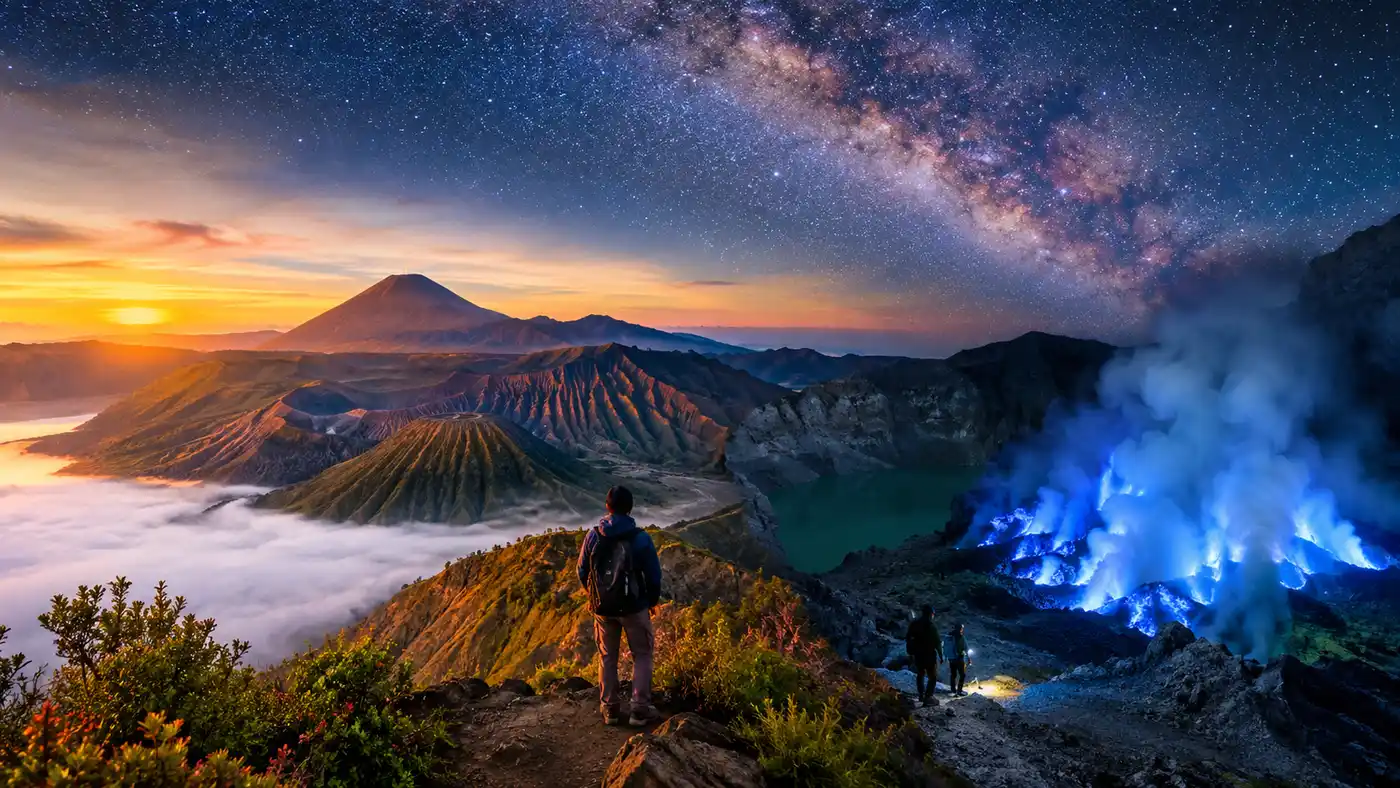
Bromo Milky Way and Ijen Blue Fire Tour
Standing on the edge of King Kong Hill at two in the morning, you will probably question your life choices. The wind cuts right through three layers of fleece, your nose runs constantly, and fine volcanic dust grits between your teeth every time you take a breath. Then you tilt your head back. Above the silhouette of Mount Batok and the smoking maw of Mount Bromo stretches a dense, iridescent band of billions of stars, so sharp and quiet it feels like someone pulled down a velvet sheet pricked with hot needles. Setting up an organized mt bromo milky way and ijen blue fire tour requires enduring some of the most exhausting, sleep-deprived travel hours Java can throw at you, but standing beneath that sky resets everything.
This trip bridges two completely different planetary landscapes across East Java. You begin in a freezing, windswept caldera staring into deep space, then travel east across lush highland plantations to scramble down an active volcano shaft where electric blue flames seep from rock fractures in the dark. It is chaotic, bone-rattling, and intensely physical. Most people try to cram both volcanoes into a whirlwind schedule without understanding the strange microclimates, the punishing timeline, or the astronomical calendar required to actually see the Milky Way clearly.
Book your bromo ijen tours experience:
Planning a Mount Bromo Milky Way Ijen Crater Tour 3 Days in Advance
Astrophotography in the tropics is a fickle game. If you rock up to East Java in December expecting crystal-clear views of the galactic core arching over the caldera, you will spend your night staring at thick gray cloud banks while rain turns the volcanic ash into knee-deep black mud. The season dictates everything.
Between May and September, the dry southeast monsoon pushes dry air from Australia across Java, sweeping away the heavy atmospheric haze. June and July are usually the driest months of the year, though temperatures at night drop to around 4 or 5 degrees Celsius on the caldera rim. Moon phases matter just as much. You need a new moon window. Even a half-moon washes out the fainter arms of the Milky Way, reducing what should be an overwhelming cosmic cloud to a faint smudge on your camera sensor. Check lunar charts months before booking any plane tickets to Juanda Airport.
Pro tip: Keep your camera batteries inside your fleece pocket against your body heat until the very minute you mount the tripod, because the bitter cold on the caldera rim can drain a fresh lithium pack in under 35 minutes.
Sleep becomes a purely theoretical concept on this route. You will not get a normal eight-hour rest period for three solid days. Instead, you snatch two-hour naps in bumping minivans, on hard homestay beds, or sitting upright in a cold Toyota Land Cruiser idling beside a cliff edge. If you accept early on that you are paying to witness geological extremes rather than taking a relaxing holiday, the brutal hours become part of the adventure.
Photographing the Night Sky: Mount Bromo Milky Way Camping Ijen Crater Tour Options
Most commercial excursions take you to a homestay in Cemoro Lawang around midday, give you a few hours to wander, and then tell you to sleep until the 3:00 AM jeep convoy leaves. That completely misses the Milky Way. By 3:30 AM, civil twilight begins creeping across the eastern horizon, drowning the fainter stars in pale cobalt blue.
A true bromo-ijen milkyway tour gets you into position by midnight or 1:00 AM at the latest. Serious photographers often choose a mount bromo milky way camping ijen crater tour, pitching tents along the high ridges of Mount Penanjakan or down inside the Sea of Sand itself. Camping puts you right on location without dealing with the snarling line of four-wheel-drive vehicles that clog the narrow ridge road between 2:30 AM and sunrise. It gets fiercely cold in a tent, honestly. Frost often coats the nylon rainfly by 3:00 AM, but crawling out of your sleeping bag to immediate, unobstructed darkness makes the misery worth it.
- King Kong Hill viewpoint: high vantage over the entire caldera, though wind exposure can shake lightweight travel tripods violently.
- Seruni Point lower platform: easier walk from town, less vehicle noise, and great foreground angles featuring classic Tengger Hindu shrines.
- Sea of Sand caldera floor: surreal flat plains where you can frame Batok against the southern sky, completely isolated from the headlamp crowds above.
- Love Hill (Bukit Cinta): slightly lower elevation, softer winds, but requires scouting early afternoon to find compositions without power lines cutting through.
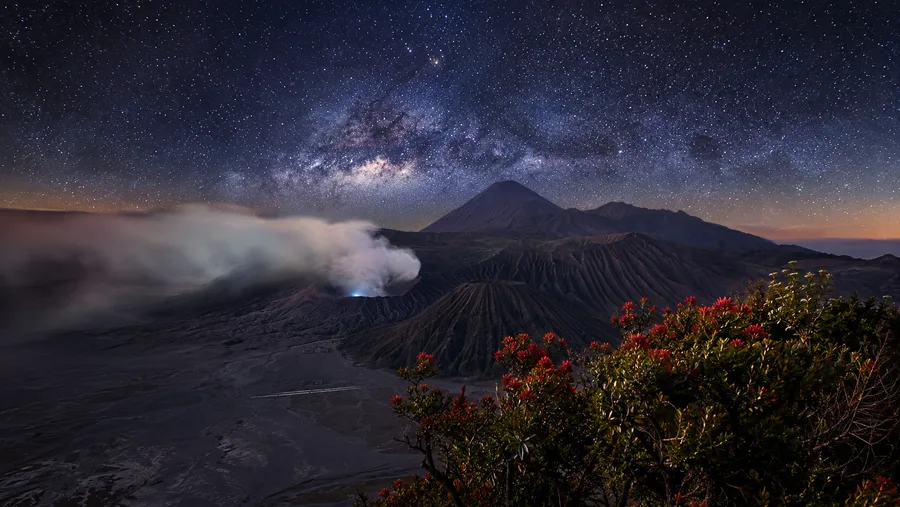
Framing the shot requires patience. You want Batok's rippled, pleated slopes in the foreground, with Bromo's active crater puffing sulfur steam to the right. Use a fast wide-angle lens, ideally 14mm to 24mm at f/2.8 or wider. Set your ISO somewhere between 3200 and 6400, and keep your exposure under 25 seconds to avoid star trailing. When Bromo burps a cloud of volcanic ash, illuminated from below by the distant headlights of early jeeps, your long exposure captures an almost alien scene.
The Route: Surabaya to Bromo Ijen Blue Fire Tours Itinerary Breakdown
Most travelers start their journey from the provincial capital. Taking a Surabaya to Bromo Ijen tour is the most practical transit route because the international airport handles cheap direct flights from Singapore, Kuala Lumpur, and Jakarta. From the arrivals terminal, you face a four-hour drive through sprawling industrial suburbs before the road twists steeply up through cabbage patches and pine forests toward the Bromo rim.
The pace is punishing. After shooting the stars and catching the golden hour sunrise over Bromo, you drop into the crater floor for a bromo sunrise tour ijen crater hike up the concrete steps to peer into the roaring volcanic belly. By 9:00 AM, while regular tourists are eating breakfast pancakes, you are back in your vehicle starting the grueling seven-hour transfer east toward Banyuwangi or Bondowoso.
| Stage | Elevation | Typical Night Temp | Key Highlight | Physical Challenge |
|---|---|---|---|---|
| Bromo Caldera Rim | 2,329 m | 4°C to 9°C | Milky Way & Sea of Sand sunrise | Bitter wind chill & loose ash walking |
| Overland Transit | 300 m | 28°C to 32°C | East Java rural landscapes | 7-8 hours in bumpy minivan traffic |
| Ijen Crater Base | 1,850 m | 12°C to 16°C | Paltuding base camp prep | Pre-midnight wake-up call |
| Ijen Crater Rim & Floor | 2,386 m | 8°C to 12°C | Blue fire & turquoise acidic lake | Steep descent, dense sulfur gas |
East Java's roads will test your patience. Heavy sugarcane trucks crawl up two-lane mountain passes at fifteen kilometers per hour, and your driver will pass them on blind corners with a casual flick of the high beams and a tap of the horn. Try to sleep during this drive. Put your headphones on, block out the aggressive braking, and let the motion rock you off. You will need every shred of energy for what happens at midnight.
Book your bromo ijen tours experience:
Descending into the Dark: Ijen Blue Flame and Crater Lake
You reach the Paltuding ranger station at the foot of Mount Ijen around 1:00 AM. The air here smells different than Bromo. Bromo smells like dry ash and ancient dust; Ijen carries a sharp, rotten-egg tang that scratches the back of your throat even at the parking area. This is where your bromo ijen blue flame tour shifts from a scenic drive into a real mountain hike.
The trail begins innocently enough on wide dirt, but within twenty minutes the slope hits a punishing 30-degree incline that does not let up for nearly two kilometers. Dust rises under the boots of hundreds of hikers. Then you reach the rim, strap on your heavy industrial respirator, and look down into the crater. Down there, hidden in pitch darkness, dancing neon-blue flames lick out of rock crevices like broken gas pipes on a city street.
Note: Standard surgical masks or basic carbon dust filters are completely useless against high concentrations of sulfur dioxide; you need a proper half-face respirator with multi-gas vapor cartridges or you will be choking violently within seconds of stepping into the crater.
The climb down inside the caldera is treacherous. You are scrambling over loose, slick boulders on a single-track path while sulfur miners heave 80-kilogram baskets of solid sulfur up the same rocks. These men carry crushing weights in split-bamboo baskets balanced on bare, scarred shoulders. Give them right of way always. Step against the rock face, steady your boots, and let them pass. What is an exotic midnight photo shoot for you is a brutal daily livelihood for them, earning roughly $12 for a load that would buckle an average gym-goer's knees.
- Proper footwear: wear broken-in trail runners or hiking boots with deep lugs; worn sneakers will slip on the smooth, sulfur-coated rocks inside the pit.
- Half-mask respirator: test the seal against your cheeks before starting down the crater wall; facial hair can prevent an airtight fit.
- Clear safety glasses: acidic smoke stings bare eyes relentlessly; wrap-around protective glasses keep tears from blinding you on narrow ledges.
- Durable headlamp: keep both hands free for balance while scrambling; handheld smartphone lights are a dangerous recipe for twisted ankles.
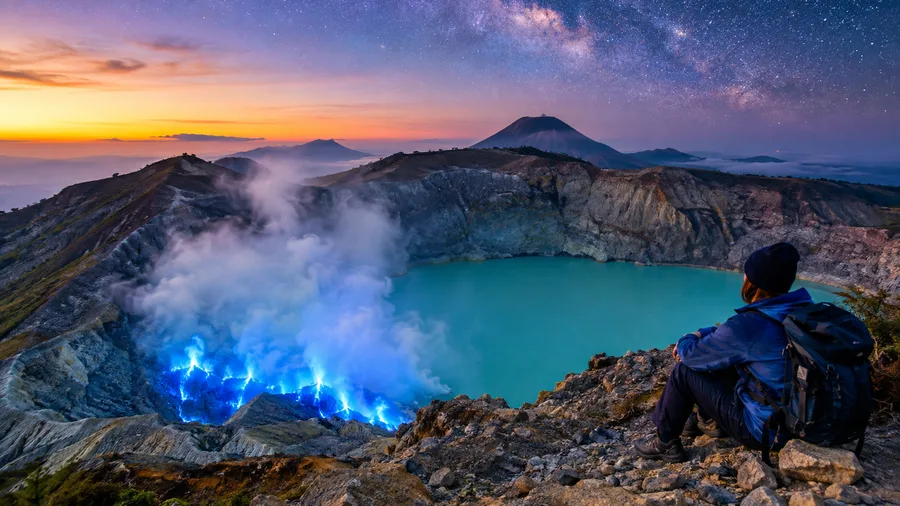
The famous electric blue fire is actually burning sulfuric gas, emerging from vents at temperatures exceeding 400 degrees Celsius and igniting upon contact with oxygen. It only shows its color in complete darkness. As dawn breaks around 5:15 AM, the blue light vanishes, replaced by massive billows of yellow-white smoke swirling across the largest highly acidic lake in the world. The water is an unearthly, creamy shade of pale turquoise, beautiful to look at and corrosive enough to dissolve metal in short order.
Surviving the Logistics of an East Java Photography Trek
Most travelers choose a classic 3-day and 2-night itinerary to tackle these sights without collapsing from exhaustion. Trying to do this independently by public bus is technically possible, but it eats up days waiting at rural terminals for minibuses that only leave when completely packed with sacks of shallots and local passengers. A dedicated bromo ijen jeep tour package handles the chaotic logistics, national park permits, and local mountain guides who know the shifting wind patterns down inside Ijen's crater.
Food along the way is simple highland fuel. You will eat plenty of nasi goreng, instant noodle soup with greens, boiled eggs, and sweet fried bananas washed down with thick, gritty black coffee brewed straight in the glass. It is unpretentious, cheap, and surprisingly comforting when your fingers are numb from the alpine chill.
By the time your tour drops you off at the ferry terminal in Ketapang to cross over to Bali, or loops back toward Surabaya, your clothes will reek of volcanic gas. That sulfur smell does not wash out easily. It lingers in your backpack straps, your shoe laces, and your jacket lining for weeks afterward, serving as a stubborn sensory reminder of sleepless nights spent chasing celestial dust and liquid fire.
Frequently Asked Questions about mt bromo milky way and ijen blue fire tour
What camera settings should I use for shooting the Milky Way at Mount Bromo?
Use manual mode with your widest lens at its lowest aperture, such as f/2.8 or f/1.8. Set your shutter speed between 15 and 20 seconds to prevent star movement, crank the ISO to 3200 or 6400, and manually focus on a distant star using digital magnification on your screen.
Can children or older travelers safely descend into Ijen to see the blue flames?
The climb up Mount Ijen's exterior is physically demanding, but descending into the crater itself is steep, loose, and hazardous. Anyone with respiratory conditions, asthma, or limited agility should stay on the crater rim to view sunrise, skipping the dangerous descent into the sulfur vents entirely.
Do I really need a warm winter jacket in tropical Indonesia?
Yes. Early mornings on the Bromo caldera frequently drop to 4 degrees Celsius, and steady high-altitude winds make it feel well below freezing. Bring a windproof winter shell, thermal base layers, a fleece, and warm gloves.
Where does the tour usually end?
Most travelers either return to Surabaya for outbound flights or continue east to the ferry port at Ketapang in Banyuwangi, which provides a simple thirty-minute boat crossing to West Bali.
Quick Reference
- Peak season: May through September (dry new moon periods)
- Bromo night temperatures: 3°C to 8°C (windproof layers mandatory)
- Ijen hike: 3 km uphill track, plus 800 m rocky crater descent
- Essential gear: 3M half-mask respirator, 300+ lumen headlamp, wide f/2.8 lens
Book your bromo ijen tours experience:
Is It Worth the Lost Sleep?
You will finish this journey dirty, sunburned, and bone-tired. Your legs will ache from the steep volcanic scree, and you might spend an entire afternoon sleeping off the exhaustion in a quiet hotel room. But watching the cosmic dust of the Milky Way arch over an active caldera, followed twenty-four hours later by the sight of natural blue flames dancing in the darkness of an acidic sulfur mine, is an experience that very few places on Earth can offer. Pack warm layers, buy the proper gas mask, book during the new moon, and embrace the wild rhythm of Java's volcanic spine.
Read more about bromo ijen tours.